 Centrum Badań nad Kulturą i Mentalnością Dawnej Polski
Editorial Dilemmas of the Humanist – Call for Papers, Cracow 2026
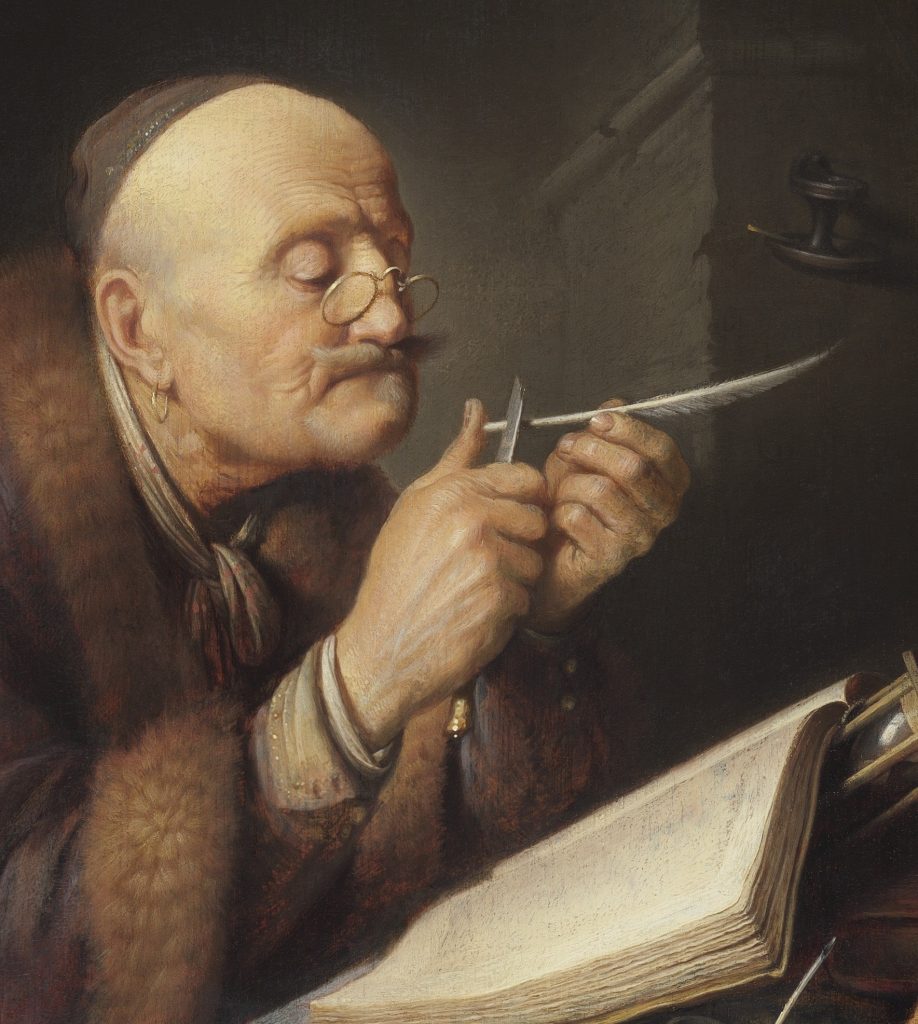
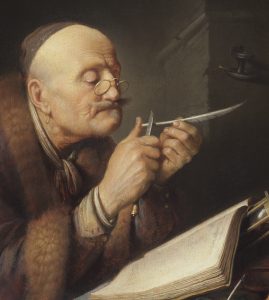
Gerrit Dou, Scholar Sharpening His Quill (c. 1632–1635).
On 22–23 October 2026, Cracow will host the interdisciplinary academic conference “Editorial Dilemmas of the Humanist”, devoted to the contemporary challenges of editing early modern and modern sources. The conference is organized by the Institute of History and Archival Studies, University of the National Education Commission, Krakow, and the Center for the Study of Culture and Mentalities in Early Modern Poland.
Conference dates: 22–23 October 2026
Venue: University of the National Education Commission, Krakow
Submission deadline: 30 June 2026
Conference fee: 400 PLN (covers meals, coffee breaks, and conference materials; payable by 10 September 2026)
About the Conference
“Wcześniej jako muchy po cukrze, a teraz jako kurczęta piszesz Waść”
[Once you wrote like flies upon sugar; now you write like chicks pecking – a Baroque rebuke from one correspondent to another, on the dwindling of letters]
The preparation of source editions has long been one of the most demanding tasks in the humanities. Almost every scholar has at some point struggled with editorial problems: the difficulty of deciphering manuscript hands, language barriers, the challenge of grasping the author’s intentions, the complexity – or, conversely, the intellectual poverty – of an early modern mind. Beyond questions of legibility lie deeper dilemmas: Is this text useful to a wider readership? Does it deserve to be edited at all? And once that decision is made, the editor faces a long sequence of further choices – from formal preparation, critical apparatus, and the deciphering of abbreviations and idiosyncratic signs, to seemingly prosaic but never trivial matters of transliteration, style, and grammar. The standard editorial guidelines, established long ago, may seem to have settled these questions – yet in practice, the problems multiply rather than diminish.
Research questions are changing, and so too are the media, tools, and modes through which sources are made available. The humanist today works not only with manuscripts and printed books, but also with maps, iconographic and costume materials, databases, digital archives, and complex multi-layered cultural objects. The contemporary reader of source editions has different expectations and different cognitive habits. Should not the principles of editorial work, then, also change – particularly when scholars themselves are losing their way among these complexities?
We invite you to a shared reflection on the contemporary challenges of scholarly editing. We are interested both in the classical problems of editing early modern texts and in newer methodologies drawn from digital humanities, cartography, archives, museums, translation, and the editing of multimedia sources.
Suggested Themes
We propose, but do not limit the discussion to, the following research areas:
- The limits of editorial intervention: between fidelity to the source and readability of the text
- Transliteration, transcription, modernization, and commentary – editorial decisions and their consequences
- Editing multilingual sources and the problems of translation in editorial work
- Editing ego-documents – correspondence, memoirs, diaries, miscellanies (silvae rerum), chronicles, and household accounts
- Editing monastic and conventual sources
- Editing official documents – court records, administrative documents, and other manuscript sources
- Difficulties and challenges in editing Polonica
- Editing cartographic, topographic, and spatial sources
- Digital tools supporting the reading, preparation, and dissemination of sources
- The contemporary reader and the source edition: usability, accessibility, didactics
- Failures and mistakes in editorial practice
- Source editions – perspectives and challenges
We hope you will find among these themes problems that resonate with your own research interests, and we remain open to further suggestions that will enrich the interdisciplinary character of our discussions.
Submission Guidelines
We invite proposals for 20-minute papers. Please submit your title and a short abstract (1,000–1,500 characters) by 30 June 2026 to one of the following addresses:
Selected papers will be published in a peer-reviewed monograph or in a journal listed by the Polish Ministry of Science and Higher Education.
Organizing Committee
Prof. dr hab. Bożena Popiołek
Dr hab. Urszula Kicińska, prof. UKEN
Conference Secretaries:
Dr Karolina Kwaśna
Dr Jarosław Pietrzak